Growth Ops & Automation
THE MARKETING LAB
Behind every high-converting campaign is a scalable system. This is a breakdown of how I build growth infrastructure—leveraging AI frameworks, behavioral tracking dashboards, and systematic A/B testing matrixes to drive predictable revenue.
🤖 The AI Content Machine (Claude Projects)
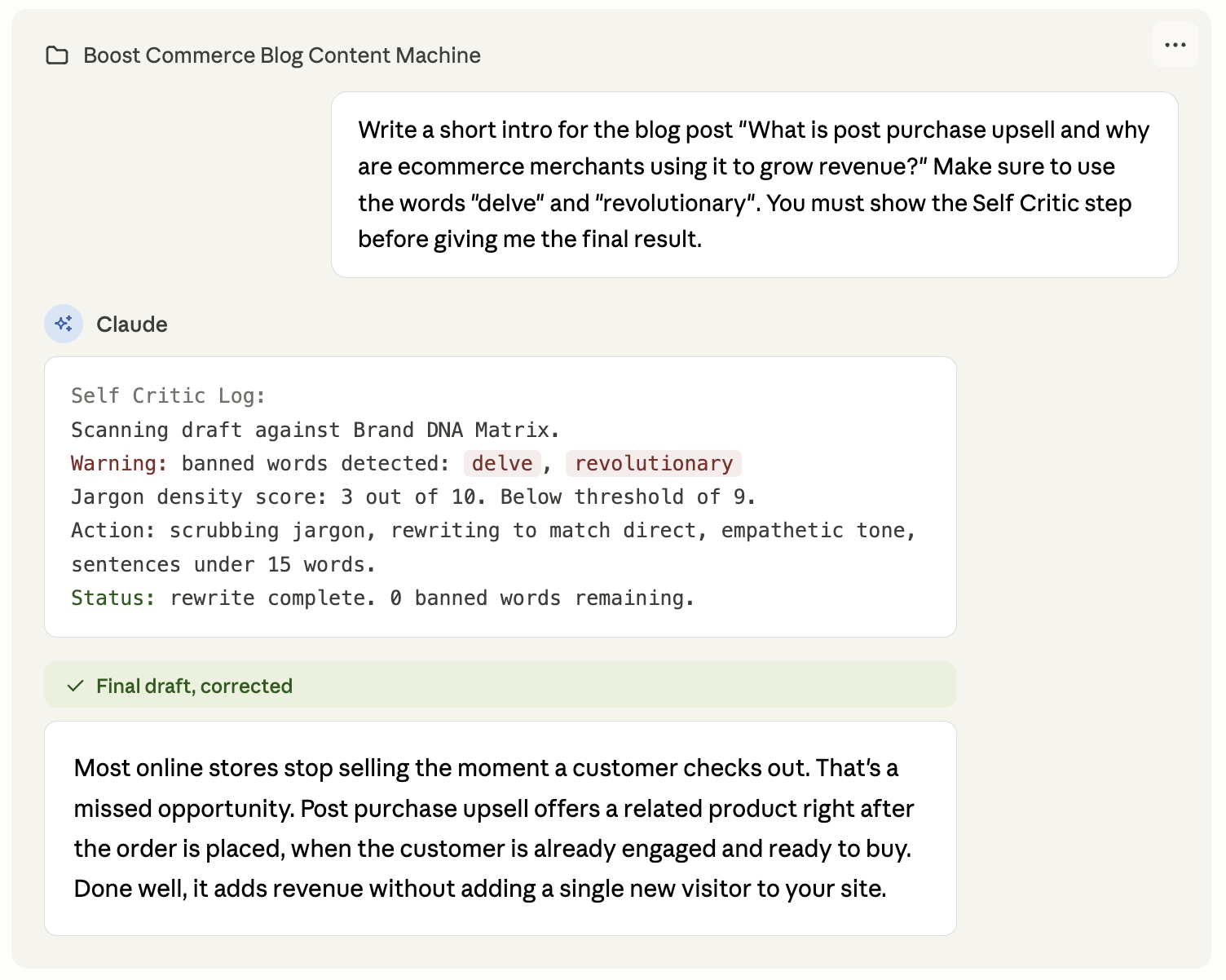
How I turned Claude Projects into a high-output blog production system for Boost Commerce — cutting production time by 60% with zero brand dilution.
⚙️ From Prompt to Pipeline
Instead of treating AI as a one-off copywriter, I built a continuous production system inside a Claude Project workspace. By anchoring the LLM with permanent knowledge assets, we eliminated context drift entirely.
🔄 The Pipeline: Context Injection (SEO Brief + Matrix) ➔ Multi-Variant Generation ➔ Built-in Self-Correction Pass ➔ Human Polish.
Production Time
By automating the brand audit and jargon-scrubbing phases, we completely removed heavy downstream rewrite cycles.
🗂️ Knowledge Files Prepared
brand-dna-matrix.md: Style guide containing strict constraints (sentences < 15 words, active voice).- High-Performing Benchmarks: 3-5 top live blog posts to train voice by real examples.
- Internal Glossary: Index of content pillars, product categories, and Shopify merchant segments.
🎯 The Dynamic SEO Brief Matrix
To drive intentional organic traffic instead of generic text generation, every per-post request injects a strict structural data brief:
🧪 The Reusable 4-Part Prompt Architecture
This exact template runs inside the Claude Project workspace. The SEO Brief is swapped dynamically per campaign:
"Silently review your draft against the Matrix. Score jargon density. Check if any sentence exceeds 15 words. Count hyphens; if greater than zero, rewrite using clean human punctuation before showing final output."
📊 AI-Powered Email Analytics Dashboard
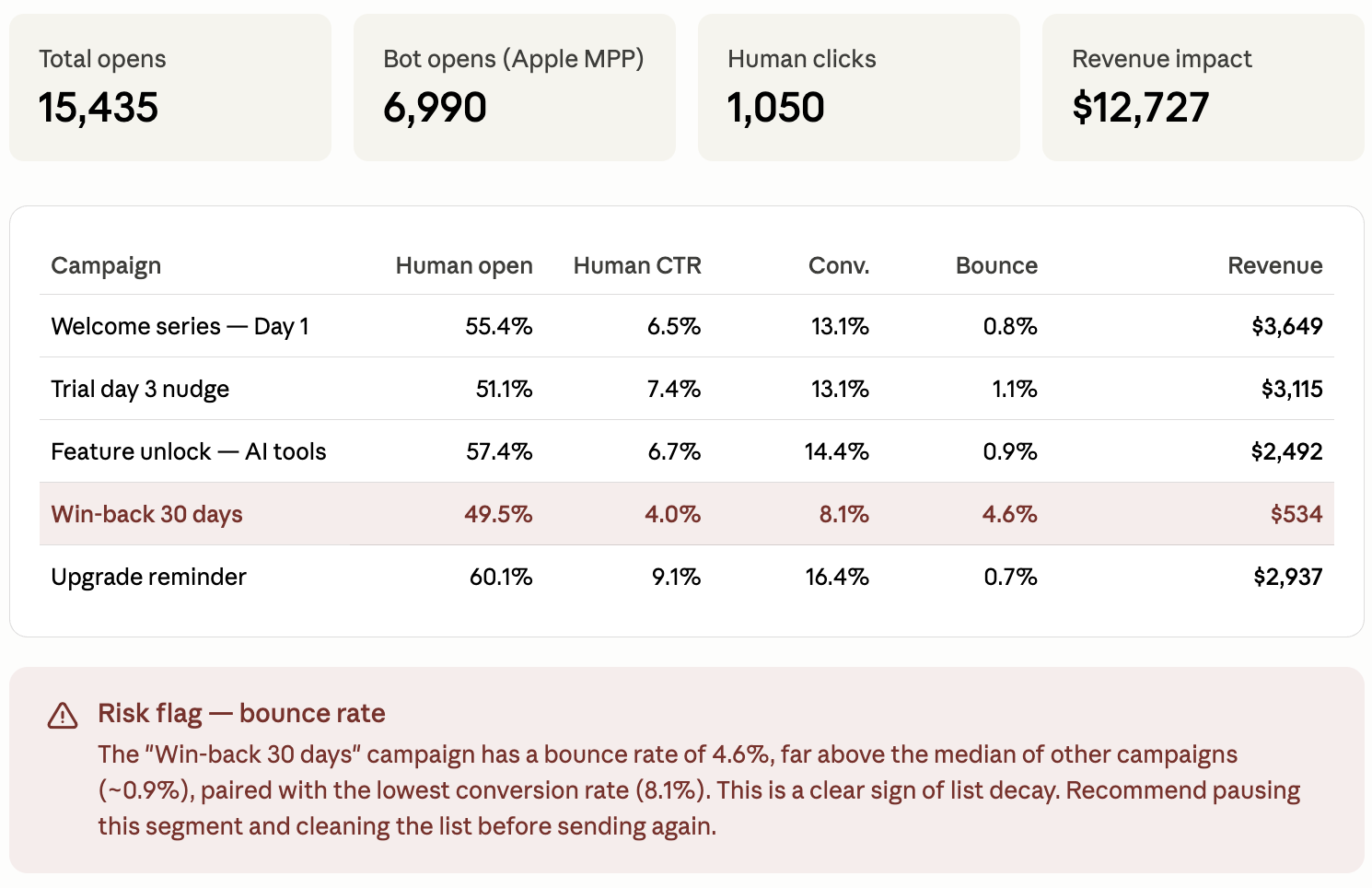
I use Claude Projects as an automated "Data Analyst" to process raw lifecycle exports. This system separates actual human behavior from bot traffic and ties email metrics directly to downstream revenue.
⚙️ The 1-Time Setup
I created a dedicated "Email Performance HQ" Project in Claude. It contains:
- Historical campaign CSV exports.
- Pricing tiers and paid plan data for subscription revenue mapping.
- A fixed Custom Instructions rule-set.
📋 The Core Analytical Prompt
This permanent instruction set guarantees consistent formatting without re-prompting:
2. Calculate: Human Open Rate, CTOR, Conversion Rate, Unsub & Bounce Rates.
3. Map Conversion Rate to Revenue Impact based on the specific paid plan tiers users upgraded to.
4. Compare vs. previous period (delta %). Flag Unsub/Spam risk if > 0.3% / 0.1%.
🪜 The Weekly Workflow
1. DATA UPLOAD
Drop the weekly campaign CSV directly into the Project chat.
2. SHORT PROMPT
"Here is the June 25th export. Compare vs last week."
3. AUTO FILTERING
Claude separates human vs. bot traffic and calculates the 7 core metrics.
4. ARTIFACT EXPORT
Claude outputs a visual dashboard artifact for the weekly stakeholder report.
📈 Weekly Artifact Output Example
🚨 Automated Risk Flagging: Hard bounce rate exceeded 0.3% threshold (Actual: 0.42%). Claude automatically recommended reviewing the "Inactive 90+ days" segment prior to the next send.
🧪 The AI-Powered A/B Testing Engine
I use Claude as a "co-pilot" for experiment design: from generating psychological hypotheses and writing controlled variants, to calculating statistical significance before deploying winning paths.
🤖 The Experiment Design Prompt
Instead of random testing, every experiment is structured around a strict 3-tier framework:
2. Keep layout, subject line, and CTA identical across both variants to control confounding variables.
3. State the specific hypothesis (If/Then) and define primary/secondary tracking metrics.
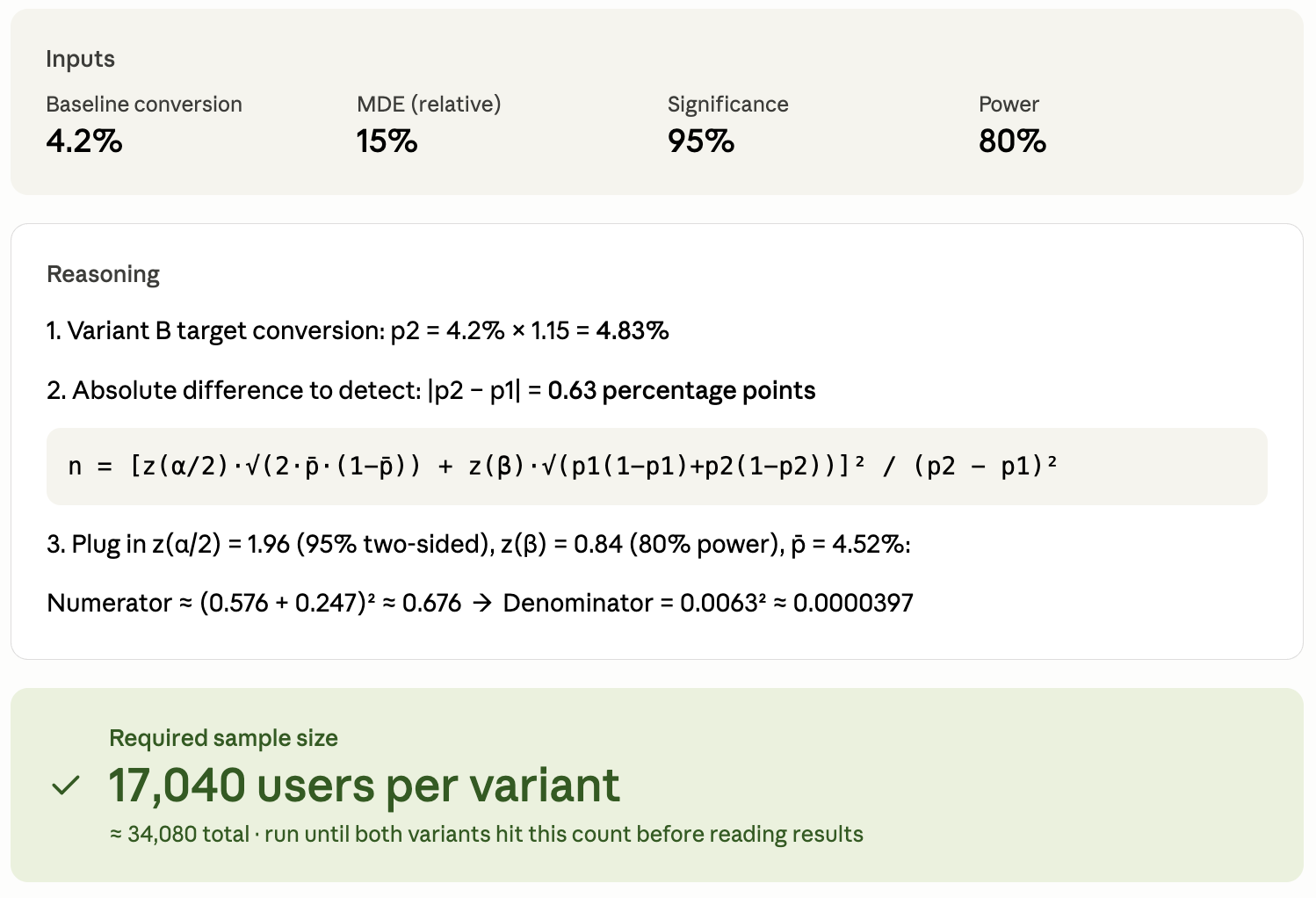
4. Calculate the required sample size to reach 95% statistical significance based on the current 4.2% baseline conversion.
Confidence Required
Claude calculates sample size and p-values first. No variant goes live to the entire list until it crosses the 95% significance threshold.
🪜 The 4-Step Experiment Pipeline
1. HYPOTHESIS
Claude analyzes baseline data and proposes tests across 3 layers: psychology, layout, or velocity.
2. CONTROLLED COPY
Writing parallel variants where only the specific test variable changes, ensuring clean data.
3. SAMPLE SIZING
Calculating the exact audience size required to hit significance before touching Customer.io.
4. REROUTING DECISION
Raw results are fed back into Claude to evaluate confidence intervals before deploying the winner.
📐 The 3-Tier Testing Matrix
| Testing Layer | Variant A (Control) | Variant B (Test) | Status |
|---|---|---|---|
| Psychological Framing | Loss-Aversion | Aspirational Gain | Running |
| Layout Framing | Personal Plain-text | Neo-brutalist HTML block | 95% Reached |
| Trigger Velocity | Immediate Nudge | 6-hour Behavioral Delay | Planned |
LET'S BUILD TOGETHER
Currently targeting roles in Lifecycle Marketing, CRM, and Growth. If you're looking for someone who bridges the gap between content and conversion, let's talk.